Thank you for your support in 2014.

Have a Wonderful Festive Season, and a Happy and Prosperous 2015!

THE GOLF ESTATE RULES THAT SENT A ST BERNARD TO THE DOGHOUSE

“To his dog, every man is Napoleon; hence the constant popularity of dogs” (Aldous Huxley)

Living in a residential estate means submitting yourself to all rules and regulations lawfully imposed by the estate’s management on residents. A recent High Court judgment illustrates.

It’s a Dog’s Life
Theodore, a large St Bernard dog, is owned by long-time residents of a Golf Estate

One of the estate’s Conduct Rules dealing with the keeping of pets – and motivated no doubt at least in part by the estate’s status as a nature conservancy – bans cats altogether and restricts dogs to breeds neither aggressive nor large (20 kg or over when mature)

Since mature St Bernards weigh in at 55 – 80 kg, Theodore’s owners were refused the required written permission to keep him on the estate

They asked the High Court to overrule this refusal, arguing that management has a discretion to allow a deviation from the rules

The Court disagreed, holding that the rules are worded in such a way as to bind management to strict enforcement of the stated restrictions (other than a “truly exceptional” case such as a guide dog for the blind)

Nor, held the Court, is it relevant that there are other large dogs already on the estate dating from a historical period of lax enforcement of the rules. Firstly, failure to enforce a breach of contract by one owner has no bearing on a breach by another owner. Secondly, whilst management did not sanction the presence of these other dogs it had been given legal advice to the effect that it would not succeed in any application for a court order removing them (which highlights a particular danger for management associations – see below)
The end result – Theodore’s owners have 3 months to remove him from the estate.

Buyers and Management Associations: Critical considerations

Buyers: Although media reports suggest that an appeal against this particular judgment is in the offing, never buy into a residential estate until you have fully understood and accepted all the rules and regulations you are agreeing to.

Management Associations: Critical to the Court’s decision in this case was the tight wording of the Conduct Rules in question – in formulating them, make sure that they will be enforceable. Take full legal advice in any doubt.

Secondly, do not make the mistake of having rules and then not enforcing them. In an earlier High Court case, the Home Owners Association of a Game Reserve was barred from enforcing its rule against the keeping of any domestic pets, because on the particular facts of that case it was held to have waived its rights to do so after an 8 year failure to take any enforcement action. Presumably that is why management in the “Theodore” case was advised to enforce its rules only against “new arrivals”.

ARE YOU ABOUT TO FORFEIT YOUR ANNUAL LEAVE?

The Basic Conditions of Employment Act (BCEA) sets a minimum of 15 annual days’ leave, and provides that this leave must be taken within 6 months of the end of your annual leave cycle. Clearly this is to encourage you to follow the healthy route of taking your leave regularly rather than accumulating it by working without a break for years on end.

Until recently however there have been conflicting court decisions as to whether or not such leave is automatically forfeited if not taken within the 6 month period.

Use it or lose it

A new Labour Court ruling has now confirmed that you will indeed forfeit such untaken leave, so keep a careful eye on how much leave you are accumulating and in what annual cycle.

Note however that we are only talking about the BCEA’s 15 day statutory minimum here – if your employment contract entitles you to more than 15 days, whether or not you can accumulate that excess indefinitely will depend on your particular terms of employment.

Employers – take note!

Your employment contracts should set out your leave policy clearly and should specifically address what rules apply to accumulation of any annual leave in excess of the 15 day statutory minimum. Remember that you cannot contract out of the BCEA’s basic conditions except to provide your employees with more favourable terms. Consequently in this case a less favourable provision in the employee’s contract – to the effect that he had to take his leave within 30 days of his employer’s financial year end – was unenforceable.

“AGREE, FOR THE LAW IS COSTLY”: USE THE NEW MEDIATION RULES

“Agree, for the law is costly” (old proverb)

Our justice system has just taken an exciting new step towards broadening access to justice. From 1 December a new “court-annexed” mediation procedure will be available (piloting initially in Gauteng and North West) to help resolve disputes without the high costs, delays and hostilities often associated with litigation.

In areas where “court-annexed” mediation is not yet available, you should still consider the existing “private” mediation procedures for settlement of your disputes. Mediation is increasingly being used by both attorneys and their clients, and hopefully this trend will be given a further boost by the introduction of the new procedures.

Moving to “Win/Win”

Litigation tends to have a “Win/Lose” feel to it, whereas mediation, being voluntary and without prejudice to your case, and with its emphasis on “restorative justice”, will provide a better chance of “Win/Win” outcomes because you and your opponent yourselves determine the settlement of your dispute with the assistance of the mediator.

How does court-annexed mediation work?
In a nutshell, an independent mediator is appointed to help you and your opponent/s resolve your dispute by helping you identify and prioritise the issues, by facilitating discussion between you, by exploring areas of compromise and by generating options for settlement.

Note that mediation is entirely voluntary and that the mediator, unlike a judge or magistrate, does not make any decisions of fact or law, nor any findings as to witness credibility. He/she will rather try to help you and your opponent reach an agreement acceptable to you both.

You can decide on mediation at any time –

Before you even begin to litigate or

After litigation has commenced, but then only with the court’s authority.

You may agree to mediation on selected aspects of your dispute only, or on the whole dispute.

Before trial commences, you can apply via a court official (clerk of court or court registrar) for mediation and a conference will then be convened to discuss whether one or more of your opponents agree to mediation.

After trial commences, the court itself hears your application, and it may also of its own accord raise the possibility of mediation with you and your opponent.

A signed written agreement to mediate is prepared with help from a court official and an impartial mediator appointed by agreement or by the court official.

You both lodge written statements of claim and defence (unless court pleadings have already been filed).

If you reach a settlement the mediator will help you draft a written settlement agreement which must be signed and can by agreement be made an order of court.

You must both contribute equally to the mediator’s fees (which are set by tariff).

Everything said and all documentation lodged during the mediation is confidential and cannot (with a few specific exceptions) be used as evidence in any subsequent court proceedings.

Can your attorney represent you?

Yes. You must attend the mediation personally, but you don’t need to go it alone. You can be legally represented, albeit at your own cost. Don’t make the mistake of waiving your right to legal representation unless you are 100% comfortable with your own ability to present your case properly and to best effect.

Is court-annexed mediation available all over SA?

Unfortunately not yet – only certain districts and sub-districts in Gauteng and North West have been gazetted for piloting from 1 December. Hopefully the rest of the country will follow shortly.

In the meantime no matter what province you are in, take advice on using the existing “private” mediation procedures as an alternative.

PROPERTY SELLERS AND ALIEN INVADERS – YOUR NEW DUTY TO DISCLOSE

“Humankind has not woven the web of life. We are but one thread within it. Whatever we do to the web, we do to ourselves. All things are bound together. All things connect” (Chief Seathl)

Property sellers: Your lives have just been made more difficult, albeit in the best of causes. NEMBA (The National Environmental Management: Biodiversity Act) imposes onerous duties on landowners and others for the control or eradication of listed plants, animals, birds, fish etc deemed to be invasive (and therefore destructive of our environment, our biodiversity, our livelihoods and our economic development).

Prior written notice to the buyer required

Now new regulations require you as a property seller to notify the buyer in writing, before conclusion of your sale agreement, “of the presence of listed invasive species on that property.”

Failure to comply will expose you to the risk of both substantial criminal penalties and potential liability to the buyer, but compliance is not going to be a simple matter. The species lists are extensive, with lists of exempted species, prohibited species, and different categories of species requiring eradication, control or application for a permit. To complicate matters even further, some species are subject to different categorisation in different provinces, so for example an invasive plant requiring eradication in one province may require only control in another. “Invasive Species South Africa” have useful lists and other resources on their website www.invasives.org.za but seek professional help in any doubt and in particular ensure that your sale agreement is correctly worded to protect you.

CIPC’S FESTIVE SEASON CLOSING DATES

CIPC (Companies and Intellectual Property Commission) offices will be closed to the public from 10 a.m. on Wednesday 24 December 2014 to 8 a.m. on Friday 2 January 2015.

Lodgment of documents will be accepted on Tuesday 23 December 2014 until 3.30 p.m.

DOMESTIC WORKERS – WAGES UP 1 DECEMBER

The minimum wage for domestic workers increases on 1 December – details on BusinessTech.

THE DECEMBER WEBSITES: RELAX ….. UNWIND ….. RECHARGE YOUR BATTERIES FOR 2015

Time to recharge your batteries in readiness for a happy and productive 2015.

Relax, unwind a bit.

Enjoy these totally random ideas to help you on your way –
Survive your end-of-year office party: http://www.careers24.com/career-advice/work-life/how-to-survive-the-end-of-year-office-party-20140701

Check time zones, weather, sun/moon etc, and plan international Skype chats (or business meetings while you’re still in work mode): http://www.timeanddate.com

Choose a holiday hotel with help from a drone: http://www.flyoverhotel.com

Drive safely with these road safety tips: http://www.gotravel24.com/theme/feature-focus/road-safety-travel-tips

If you’re flying, book the best seat in the plane: www.seatguru.com

Check the tides before you head for the beach: http://www.kwathabeng.co.za/tides

Don’t forget also to check for perfect beach days (or approaching hurricanes and raging South-Easters) – use these wind and other animations (click on the “earth” icon for controls): http://earth.nullschool.net/#current/wind/surface/level/orthographic=-341.47,-33.81,3000

Tasked with opening the bubbly? Uncork it like an expert: http://www.goodhousekeeping.com/recipes/cooking-tips/uncork-champagne-bottle#slide-1

Share Nature! Help document our biodiversity – contribute interesting sightings of any animals, plants or fungi you encounter: http://www.ispot.org.za/

Relax .….. waste a bit of time surfing the Internet: http://www.women24.com/Trending/Fun-useless-websites-to-visit-when-youre-bored-20140509

While you’re at it, use face recognition software to see what celebrities you (and your friends and relatives) look like: www.pictriev.com

Impress everyone with your culinary skills, no matter what random ingredients you have to hand: www.supercook.com

Last (but certainly not least) learn how to talk like your lawyer: http://survivelaw.com/index.php/blogs/procrastination/812-working-hardly-talking-like-a-lawyer.

Enjoy the Break!

DEVELOPERS: REGISTER OR REGRET

Residential property developers need to note the recent Constitutional Court judgment confirming that you must register with the NHBRC (National Home Builder’s Registration Council) before you conclude a building contract or commence building – if you don’t (or if you register late) you cannot enforce payment. In fact you commit a criminal offence just by accepting any payment.

It is not enough that whichever building contractor/s you use to do the actual construction is/are registered – both you as developer and your contractor/s must be registered.

Don’t get this wrong!

The developer in question only registered with the NHBRC after the contract was concluded and building had started (in fact, only after it had applied to the High Court to enforce an arbitration award in its favour). That, held the Court, disentitled it to receive any consideration for building the house. It was irrelevant that the actual builder was properly registered and the house properly enrolled.

So the developer loses everything –
The R1,228,522 construction price, plus

Substantial interest since 2007, plus

Legal and other costs. These are no doubt very substantial indeed, the case having dragged on through arbitration, the High Court, the Supreme Court of Appeal and the Constitutional Court.

Homeowners – consider this…..

Check upfront that both the developer and the contractor/s are registered and that your home is enrolled with the NHBRC. That’s the only way you can access statutory safeguards such as vetting of builders, warranties as to the quality of construction, and access to a compensation fund for any defective work should the developer or builder fail to meet its obligations to you.

ATTACKING A TRUST (AND DEFENDING IT)

“Invincibility lies in the defence; the possibility of victory in the attack” (Sun Tzu)

It’s an all-too-common scenario. When you try to recover your money from a debtor, you find that all his/her assets (including the luxury home, holiday house and ocean-going yacht) are held by a family or business trust.

Creditors: Follow the Assets
Prevention being as always better than cure, investigate your debtor’s financial position before granting credit, and take suretyships and other security from the trust and any other related entities that actually hold any of your debtor’s assets.

Look for loan accounts and unlawful dispositions. Where assets have been transferred into a trust (or to any other third party), the transfers may be impeachable in terms of our insolvency laws. Where the asset transfers were lawful, the trust may well still owe your debtor money for their value, whether or not appropriate loan accounts are actually shown in the trust’s financial records. Such monies may then be recovered as assets in your debtor’s estate.

Attack the trust directly. A recent High Court judgment discusses two ways of achieving this. Read on below.

The Insolvent and the Properties

The trustees of an insolvent estate asked the High Court to declare that two properties, one held by a family trust and one by a company, be treated as assets in the insolvent estate.

The Court refused the application on the facts, but its analysis of the applicable law provides practical advice both to creditors (on how to attack a trust) and to the trust’s trustees (on how to protect it).

One must, held the Court, distinguish between two different lines of attack –
Firstly you can try to establish that a trust is a sham. A trust will be a sham if factually “the requirements for the establishment of a trust were not met, or ….. the appearance of having met them was in reality a dissimulation”. If it is a sham, the trust does not exist; or

If the trust isn’t a sham, it exists. But you can still ask a court to “go behind the trust form” or to “pierce its veneer”. If you succeed, the court will disregard “the ordinary consequences of [the trust’s] existence” and can for example declare trust assets to be assets in the trustee’s personal estate. “It is a remedy that will generally be given when the trust form is used in a dishonest or unconscionable manner to evade a liability, or avoid an obligation”, most likely to present, said the Court, where “trustees treat the property of the trust as if it were their personal property and use the trust essentially as their alter ego – an all too frequent phenomenon in certain family and business trusts in which the trustees are both the effective controllers as well as the beneficiaries.”

Trustees: Defending your Trust

Trusts can legitimately be used both as estate planning tools and to protect assets from the risks of business failure, but only if they are structured and administered correctly.

So take advice upfront on how to structure the trust and its founding deed, what trustees to appoint and how to appoint them, and how to manage its affairs. Avoid any suspicion that the trust is a sham or that it is being used dishonestly or as an alter ego for the trustees. In particular distinguish clearly between control of the trust’s assets and “use and enjoyment” of them.

DAMAGES FOR ADULTERY – DEAD AS A DODO?

“The Dodo suddenly called out ‘The race is over!’” (Lewis Carroll, Alice in Wonderland)

Your spouse’s adulterous affair ruins your happy marriage – can you, as the “innocent” spouse, sue the “third party” for damages?

Our law has for centuries recognised such damages claims for adultery, and these are usually based on –
Insult or injury to your self-esteem (“Contumelia” in lawyer-speak), and/or

“Loss of comfort and society” of your spouse (loss of “Consortium”).

“Time for abolition’

Now the Supreme Court of Appeal (SCA) has, in a decision setting aside an award of R75,000 damages in favour of a husband against the man with whom his wife had committed adultery, held that: “…..the delictual action based on adultery of the innocent spouse has become outdated and can no longer be sustained; ….. the time for its abolition has come”.

But is the race really over?

Despite media coverage implying that the end has come for all adultery-related damages claims, the Dodo’s assertion that “the race is over” is not entirely correct – not yet anyway.

The SCA specifically left the door open for future consideration of other marriage-related claims for “abduction, enticement and harbouring of someone’s spouse” as well as claims for monetary loss related to “…..the loss of consortium of the adulterous spouse, which would include, for example, the loss of supervision over the household and children.” In other words, third party adulterers do still run some risk of liability, and that won’t change unless and until we hear further from our courts on the matter.

WHISTLE-BLOWING: A FACEBOOK FOUL UP

“Whistleblowing should be encouraged. Employees who risk occupational detriments by making bona fide and reasonable disclosures about irregularities at the workplace if their attempts to have the employer address such irregularities, fall on deaf ears, must be protected” (extract, Labour Court judgment below)
Last month (see “Whistle(Blowing) While You Work” in LawDotNews October 2014), we looked at the case of a mining engineer who was dismissed by his employers after he made public disclosures relating to the inadequacy of their pollution prevention measures. The Court set aside his dismissal after finding that his disclosures were protected in terms of the Protected Disclosures Act (“PDA”).

“Foul Air!” he cried (online)

“Fair is foul and foul is fair
Hover through the fog and filthy air” (Shakespeare, quoted in the judgment)

The other side of the coin is illustrated in another recent case where the dismissal of a hospital electrician was confirmed as fair –
The electrician complained to management about a number of alleged health risks in the hospital, primarily of filthy air emanating from the foul toilets and circulating through the air conditioning;

The hospital replied that in its opinion there was no health hazard;

The employee nevertheless published on Facebook a series of comments, photographs, copies of internal hospital correspondence, and complaints such as: “…..filthy toilets are causing foul air to enter the air conditioning system and be pumped into the hospital wards”;

He was told that his concerns had been investigated and, to the extent that they were valid, had been addressed;

He was also told to report any further concerns to the hospital’s Occupational Health and Safety authority;

He ignored this and other written instructions, including a “final instruction” to stop his publications on Facebook;

When he persisted, he was fired for “gross insubordination” after a disciplinary hearing;

Having failed in appeal and conciliation processes, he asked the Labour Court to find that his disclosures were protected by the PDA.

The fair dismissal finding

Finding that the disclosures were not protected in terms of the PDA, the Court confirmed the employee’s dismissal, despite accepting that he “acted out of a sense of duty, albeit misplaced, and that he genuinely believed in his cause”.

The employee’s problem was that good faith is not enough; there is also a requirement of reasonableness. His belief that the dirty toilets posed a health risk through the air conditioning system was, held the Court on the facts, not reasonable. Nor had he made the disclosure in a “responsible manner”, nor in compliance with the full statutory requirements and procedures mandated by the PDA. In fact, his Facebook publications were not even “disclosures” because the problems complained of were “notorious” information and already well known.

And finally: The Facebook Factor

Finding that the publications on Facebook were “unfair” as well as “unreasonable”, the Court commented that: “The internet is, unlike the press, not subject to editorial policy: there was no prospect of a moderator contacting the Hospital for its side of the story so that the public be given a balanced perspective.”

That surely fires a warning shot across the bows of any employee unwise enough to rush into venting complaints or concerns online.

The fact is that the full requirements of the PDA are complex, so take proper advice in any doubt!

PROPERTY BUYERS: DON’T PAY THE SELLER’S OLD RATES WITHOUT LEGAL ADVICE!

You buy your dream house but are shocked to learn that (a) the seller still owes the municipality for old rates and taxes and (b) you can’t get a new electricity account unless and until you settle all these arrears. You point out how unfair it is that you are being asked to pay someone else’s debts, but the municipality won’t budge. What can you do?

Regular readers (see LawDotNews April 2014: “Rates Clearance – a New Risk for Buyers?”) will remember the controversy over whether buyers might be exposed to this type of claim in respect of rates older than 2 years i.e. those not included in the municipal clearance certificate.

Now a new High Court judgment has it seems settled the question in favour of buyers at sales in execution, holding that a municipality cannot refuse to supply such buyers services such as electricity, water, sanitation and waste removal only because of old outstanding municipal debts.

But it’s not over yet – protect yourself up front

Media reports have implied that this judgment applies to all property sales, but in fact it relates specifically to a sale in execution. That is hopefully an indication of the direction our courts will take on the question generally, and you may well be able to rely on one or more of the other arguments raised on behalf of the buyer during the trial.

So certainly if you come under pressure to settle old arrears, don’t pay a cent without legal advice.

But the fact remains that this decision (a) may not be followed generally and (b) may still be challenged. So protect yourself up front by insisting that your sale agreement requires the seller to prove before transfer that all municipal debts, old as well as new, have been settled in full.

THE NOVEMBER WEBSITE: “ICE” AND EMERGENCY NUMBERS

As the holiday season approaches many of us will be travelling, and unfortunately that increases your risk of being involved in a serious accident. Don’t be caught unprepared – put ICE (“In Case of Emergency”) numbers onto your cell phone, and make sure that all your family members do the same BEFORE travelling.

ICE numbers make it easy for emergency and hospital personnel to contact your loved ones if you can’t speak for yourself. Without ICE numbers they will have to trawl through your Contacts, and take a guess as to who to phone first. Use “ICE1”, “ICE2”, ICE3” etc for multiple numbers.

See Arrive Alive’s page “Cellular Technology and Road Safety” for more emergency numbers and suggestions.

Have a Great November!

Houses – Transfer Trumps Intention

“Experience is a hard teacher because she gives the test first, the lesson afterward” (Vernon Law)

Never assume that you have any rights to a property just because the owner says that he/she intends to give you ownership, even if a sale agreement is signed. Make sure that you actually do take ownership via registration in the Deeds Office.

That’s the hard lesson learnt recently by a mother and her children who will now be evicted from “their” home.

The relationship that soured
Mr A intended to marry Ms B, who lived with her children in a home owned by Mr A’s company

Mr A it seems intended to donate the home to Ms B and he accordingly signed a sale agreement (the “first agreement”) selling it from his own company to Ms B’s Company C (she being the sole director and shareholder)

Transfer was never effected to Company C

Mr A then left Ms B and married someone else instead

Mr A signed another sale agreement (the “second agreement”) in terms of which he sold the home from his company into his own personal name. The property was duly transferred into Mr A’s name

Mr A died, leaving the home in his will to his new wife

Ms B, still living in the home but threatened with eviction by the executor of Mr A’s deceased estate, asked the High Court to order transfer of the property to her Company C per the first agreement.

A hard lesson from the law

The High Court held against Ms B, confirming that ownership of immovable property only passes on registration of transfer in the Deeds Office.

The parties must both have had the intention of respectively passing and accepting ownership of the property from the seller to the buyer, and on the facts of this case Mr A’s intention was clearly that ownership pass in terms of the second agreement, i.e. into his personal name.

Moreover Ms B had failed to prove that the first agreement was in existence or enforceable (in cases of “double sale”, the second sale can be set aside if the second buyer is shown to have had prior knowledge of the first sale).

The mistake she made

Ms B should have pushed for transfer to her Company C as soon as the first sale agreement was signed. She seems to have assumed that the agreement itself was all she needed – a fatal mistake.

MIXED USE PROPERTIES: WHAT RATES MUST YOU PAY?

Municipalities may levy rates on properties by valuing them and then applying a rate to them based on categories of permitted or actual usage, with “residential” properties traditionally attracting lower rates than “commercial”, “business” and “industrial” properties.

What happens though when you own a mixed use property?

Property owners will welcome a recent Supreme Court of Appeal ruling in a dispute around the rates levied on a 10 storey building zoned and used for multiple permitted uses, and which had 9 residential floors above some shops on the ground floor.

The municipality’s rates policy allowed it to levy rates according to “permitted” usage, and it accordingly levied rates on the total valuation of the building under its higher “business” rate without making allowance for the actual residential usage of much of the building.

The Court, confirming that the Valuation Appeal Board had been correct to change that and rather make an apportionment of the building valuation, held that –
Where a property is being used for “multiple permitted purposes”, the municipal valuer must categorise the various uses and apportion the market value of the property between them,

The municipality must then apply the tariffs for those categories to the apportioned values.

DIRECTORS – ENVIRONMENTAL LAW AND YOUR INCREASED PERSONAL LIABILITY RISK

Government and our courts are serious about protecting the environment, and NEMA (the National Environmental Management Act) is being strictly enforced.

A new amendment to NEMA provides that directors (and members of CCs) are now jointly and severally liable “for any negative impact on the environment, whether advertently or inadvertently caused by the company or close corporation which they represent, including damage, degradation or pollution”.

Your risks are high

You risk both personal liability in a monetary sense (including the cost of remedial action which could well be substantial) and criminal prosecution, for which the penalties are severe – fines of up to R10m and/or 10 years’ imprisonment.

Note: NEMA also provides strong protection for whistle-blowers – see the next article “Whistle(Blowing) While You Work” for more.

WHISTLE(BLOWING) WHILE YOU WORK

“The fostering of a culture of disclosure is a constitutional imperative as it is at the heart of the fundamental principles aimed at the achievement of a just society based on democratic values” (Labour Appeal Court, case below)

The “Whistle-blower’s Act” (more correctly the PDA or Protected Disclosures Act) encourages employees to disclose unlawful or irregular conduct by their employers or fellow employees (in both the public and private sectors), without fear of reprisal.

What the Act requires

The full requirements for protection as set out in the PDA are complex so it is essential to take specific legal advice, but in brief summary, the requirements for a “general protected disclosure” are –
It must be made in “good faith”,

The employee must reasonably believe that “the information disclosed and any allegation contained in it are substantially true”,

The employee cannot make the disclosure for personal gain, “excluding any reward payable in terms of any law”,

“In all the circumstances of the case it [must be] reasonable to make the disclosure”.

The mining engineer who blew the whistle

A case recently before the Labour Appeal Court illustrates –
An engineer employed by a mining operation as a “project superintendent” was, amongst other duties, responsible for maintaining health and safety standards,

He was dismissed following a disciplinary hearing which found him guilty of failing to obey a reasonable instruction to return to work after a period of sick leave,

A local newspaper published an article based on his media report to the effect that the mine had inadequate measures in place to address the water pollution that its mining operations had caused,

The Court, finding on the facts that this disclosure was protected both in terms of the PDA and in terms of NEMA (the National Environmental Management Act), ordered retrospective re-instatement of the engineer with full back pay.

A twist: environmental risks

An interesting twist relevant to this case is that NEMA both –
Imposes liabilities on “managers, agents and employees for environmental transgressions committed by their employers”, and

Provides whistle-blowing protection to anyone (not just employees) for good faith disclosure of information on environmental risks “in the public interest and in the interest of protecting the environment”. Again, specific requirements and procedures apply, so take full advice in each case.

The other side of the coin: Getting it wrong with Facebook

Next month we’ll look at another case where an employee’s dismissal was confirmed as fair after he used Facebook to make disclosures about health hazards in a hospital, but did so unreasonably and outside PDA’s requirements and procedures.

IMMIGRATION REGULATIONS – TWO REQUIREMENTS POSTPONED, BUT APPLY NOW

Home Affairs have announced a postponement to 1 June 2015 of two of the new rules relating to children, namely the Unabridged Birth Certificate requirement and the requirement for written permission from both parents/guardians authorising a child’s travel.

With reports of major delays in the Home Affairs system, if you don’t have Unabridged Birth Certificates for all your children, apply for them now – whether or not you have any future travel plans in mind.

DEVELOPERS: NEW HEALTH AND SAFETY CONSTRUCTION REGULATIONS

Anyone involved in construction work, including developers and other “clients”, “designers” (architects, engineers, interior designers etc) and contractors, should familiarise themselves with the Department of Labour’s new “Construction Regulations 2014” issued in terms of the Occupational Health and Safety Act. These regulations currently apply to any construction that commenced after 7 February 2014 (earlier construction projects are affected only from 7 August 2015). They require formulation of health and safety plans, risk assessments, compliance with health and safety standards, and health and safety training.

Construction work permits and appointing agents

Developers planning any project scheduled to commence on or after 7 August 2015 should also prepare now for two further requirements that will apply from that date to specified large construction projects –
They will need a “construction work permit” before starting construction, and

They will have to appoint an “agent” who must be a registered professional Health and Safety Agent (PrCHSA).
Non-compliance will risk both “stop work” orders and the imposition of penalties and criminal liability, and as your chosen PrCHSA will need time to prepare for the permit application (which must be lodged 30 days before you start work), don’t leave this aspect of your planning to the last minute.

THE OCTOBER WEBSITE: HOW TO REDUCE THE PAIN OF QUEUING AT SARS

You can these days make your life a lot easier by interacting with SARS online for many things, but occasionally a personal visit to a physical branch is unavoidable.

Reduce the pain by checking SARS’ website page “Find the Shortest SARS Branch Queue Near You” and following these steps –

Click on this link http://www.sars.gov.za/Contact/Pages/Check%20the%20shortest%20queue.aspx

If a Windows Security box pops up, click “Cancel”

Click on the link in “Step 1” to the “Branch Locator” page

Ignore the map, click on your Province in the black menu bar at the top e.g. “Eastern Cape”

Then click on your nearest branch in the same black menu bar e.g. “East-London”

“Best times to queue” is at the bottom of the page.

Have a Great October!

Property Fraud: Buyers, Bondholders Beware

“Our system of deeds registration is negative: it does not guarantee the title that appears in the deeds register” (extract from first judgment below)

Although in practice title deeds as registered in the Deeds Office are accepted as proof positive of property ownership, two important SCA (Supreme Court of Appeal) decisions illustrate a little-known but potentially serious danger here.

Case 1: Forgery most foul

The facts of the first case were these –

Confirming this order on appeal, the SCA commented that “….. where registration of a transfer of immovable property is effected pursuant to fraud or a forged document ownership of the property does not pass to the person in whose name the property is registered after the purported transfer”.   Where there is no “genuine intention to transfer ownership” on the part of the seller, ownership does not pass and registration in the Deeds Office has no effect.

Case 2: Fraud even fouler

The second SCA case involved a homeowner whose inability to pay her bond instalments led to the bank attaching her house.  Desperate to raise a loan, she approached a property investment company whose agent fraudulently tricked her into signing sale and leaseback agreements – she thought she was signing paperwork to raise a loan.

Confirming that where a sale agreement “….. is tainted by fraud, ownership will not pass despite registration of transfer”, the SCA upheld a High Court order for reregistration of the house into her name.

The bottom line – investigate!

The danger of fraudulent transfers taking place seems to be particularly high at the moment, with media reports of high level investigations into alleged fraud, corruption and maladministration in our Deeds Office system.

Both buyers and bondholders are at risk here, and need to investigate thoroughly at the slightest hint of anything amiss in a property transaction – taking Deeds Office records at face value isn’t always as safe as it seems!

BUSINESS RESCUE AND SURETYSHIPS: CREDITORS AT RISK

Consider this scenario.  It’s unfortunately one all too likely to face creditors in these hard times –

But before you relax too much …

The outcome of a series of recent court decisions is that your suretyships could well become worthless if your main claim is compromised in an adopted business rescue plan (it normally is).

In the most recent case, the High Court held that –

Preserving your suretyship claims – a checklist

1.   Before you grant credit in the first place –

a.  Have your lawyer check your standard suretyship forms – are they correctly worded?

b.  Take advice on replacing them with full guarantees from directors (as some commentators are suggesting).

c.  Look also for security other than just the suretyships – cessions of debtors, bonds over properties etc.

2.   Then if a debtor goes into business rescue, immediately –

a.  Take advice on how best to enforce/preserve your rights against the surety/ies.

b.  Secure your position well before you are called on to consider any business rescue plan

The cost of getting this wrong could be high – the creditor in this case is down R370k.

THE EMPLOYMENT EQUITY CHANGES – DO THEY APPLY TO YOU?

(Note:  What follows is of necessity only a brief summary of a few highlighted amendments to a complicated piece of legislation – take advice on your specific circumstances)

All employers and employees need to take account of the recent amendments to the Employment Equity Act.

What parts of the Act apply to you?

  1. The “Prohibition of Unfair Discrimination” provisions apply to all employers and employees.
  2. However the “Affirmative Action” provisions apply only to “designated” employers and to employees from “designated” groups (broadly, SA citizens who are black, female or disabled).

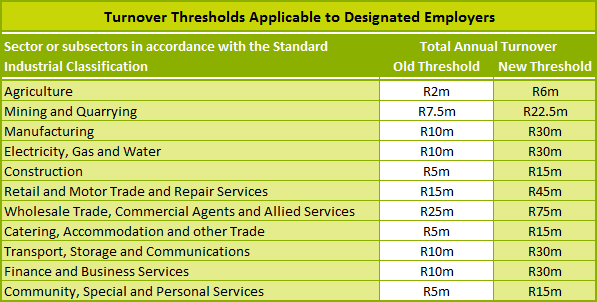
Affirmative Action: Are you a “designated” employer?

The requirements to prepare employment equity plans and to implement specified affirmative action measures will (with a few specific exceptions) only apply to you if you either –

Turnover Thresholds Applicable to Designated Employers
What is “Unfair Discrimination”?

On the other hand, all employers are bound by prohibitions against any form of “unfair discrimination” i.e. discrimination based directly or indirectly on any one of the generally prohibited grounds of “race, gender, sex, pregnancy, marital status, family responsibility, ethnic or social origin, colour, sexual orientation, age, disability, religion, HIV status, conscience, belief, political opinion, culture, language, birth or [this last bit is new] any other arbitrary ground”.

The new rules on equal work, equal pay

An employer is now prohibited from differentiating between employees in regard to “terms and conditions of employment” (which would include remuneration, working conditions etc) in circumstances where –

Beware the increased penalties

Contraventions of the Act carry greatly increased penalties, with first offenders risking a fine of the greater of R1,5m (tripled from the former maximum of R500,000) or 2% of turnover.

LIVING WILLS: WHAT ARE THEY AND DO YOU NEED ONE?

“No one can confidently say that he will still be living tomorrow” (Euripides)

We will all die. We have limited control over what will eventually kill us and when, but there is something that we can do now, whilst we are still physically and mentally capable of doing so, to express our wishes as to how we die.  Specifically, we can give instructions now as to what medical treatment we want to be given at the end.  For many people a nightmare scenario is to be kept artificially alive, quite possibly in pain and distress, long after your medical condition becomes hopeless and long after you have lost the ability to express your wishes for yourself.  If you are one of those people, consider executing a Living Will – but do it now, while you still can.

What is a “Living Will”?A Living Will is your personal “advance health care directive”, executed by you before you lose the ability to do so, in which you tell doctors, hospitals and your loved ones what end-of-life medical treatment you do and do not consent to.  For many people it will be an expression of your wish to be allowed to die naturally, with the support of only such medical measures as will relieve your distress and pain without pointlessly prolonging your life.  It will speak for you when – and only when – you are no longer capable of doing so yourself.

It will be easier for your family and doctor to make the necessary decisions on your behalf if you have previously run through with them any “What if …..?” scenarios that particularly concern you (or them), and if your wishes in each such scenario are clearly expressed and understood.   Most importantly, make sure that everyone knows exactly where your Living Will is – they may need to find it in a hurry.

You also need a “Last Will and Testament”!

Note that a Living Will isn’t a “will” in the normal sense of a “Last Will and Testament” regulating the distribution of assets to your heirs after you die.  You certainly do need to execute such a will right now if you don’t already have one, but a “Living Will” is a very different thing.  You need both.

Is a Living Will valid?

This isn’t the same as euthanasia or “assisted suicide”, which remain unlawful in South Africa, as well as running foul of many people’s moral/cultural/religious objections.  But whereas euthanasia and assisted suicide involve an active intervention to terminate life, a typical Living Will merely expresses your wish that nature be allowed to take its course when the time comes.

Although the enforceability of your Living Will cannot be guaranteed (the legal principles involved are yet to be tested in our courts), at the very least it should make it easier for your loved ones (and the medical professionals charged with caring for you at the end) to take hard decisions if and when they need to be taken.

TAX DISPUTE?  NEW RULES, REQUIREMENTS

If you are unlucky enough to end up in a dispute with SARS, following the correct procedures – and in particular complying with the required time-frames – is critical.  Be aware of new regulations specifying detailed procedures for objections, appeals, ADR (alternative dispute resolution), Tax Court applications etc.

This is a specialised field and the stakes are high – take advice from a registered tax practitioner in any doubt.

THE SEPTEMBER WEBSITE: GRAB A GRADUATE

It isn’t easy these days for a new graduate to find suitable employment, particularly with a CV that is devoid of relevant work experience.Equally, many SMEs would benefit from being able to access the skills, youthful energy and creativity of a new graduate.  But they balk at taking on the risk and cost of permanently employing someone unknown and untested.

The win-win answer for both unemployed graduates and SMEs may be a fixed-term internship.  See for example the “GAP” Graduate Asset Programme (at www.gogap.co.za) which connects businesses with graduate interns via a free matching portal.  The site also provides a wealth of information and resources – for more, download their online pamphlet “Grab a Graduate – Get the intern advantage!” from their Business Tools page at www.gogap.co.za/toolshed/download/111.

Note:  Copyright in this publication and its contents vests in DotNews.

Bate Chubb & Dickson Inc. is one of the older law firms in the country and the impressive reputation that it has built over the years stems from its continued commitment to excellence.